
2026: moving with intent
a manifesto on figuring out where we are, where we want to be, and how to get there
happy new year, all!
I think 2025's been a pretty good year! I landed on my feet, managed to accomplish so much more than I expected, and capped off the year at my first Chaos Communication Congress. all around, it was a pretty good year.
one of the highlights of 2025 has been starting a new job. since February, I've worked on building out the product and platform at a startup. in the process, I've found myself consistently coming back to the concept of moving with intent.
the thesis? if you've got a limited amount of some resource (in a startup's case, it's most likely capital), you not only have be mindful as to how you use it, but intentional with how you consume each and every unit.
you can't simply hope a risk you take will pay off, throw cash or staff at a problem and hope it resolves itself, or encourage people into the office for three days a week and hold your breath, waiting for a "water-cooler moment". you need a concrete plan to deploy resources, and then need to spend time implementing it and monitoring your performance over time. if necessary, you make changes to the plan (or your implementation of the plan) to get better results.
to effectively challenge an incumbent, you cannot emulate their inefficient processes and wasteful spending. you have to be smarter, more focussed and more intentional with how you use your resources.
I think this is a useful principle to apply to one's personal life. as a individual, you're constrained on several fronts; you have limited lifespan, limited capital, limited energy and limited attention. you need to be mindful in how you expend your resources to achieve certain outcomes.
bearing all this in mind, moving with intent personally involves
- seeing the world as it is (your resources),
- seeing it for what it could be (your plan),
- becoming proactive and resilient (adjusting your plan).
I'd like to make this mindset my theme for 2026, as I do more events, meet more people and build more cool things. I plan to ask myself "how does what I’m doing right now get me where I want to go?"
when it comes to seeing the world as it is, your resources include the tangible: your capital and your possessions. however, it also includes the intangible. for example, you're not getting any younger, so your time, health and energy are resources which will be consumed whether you like it or not. similarly, simply doing things takes from your attention and motivation. you should budget all these carefully.
the intangible resources you have also includes the skills, abilities and random things you’ve collected over the years. you have a lot of resources granted to you by virtue of your position in social groups; sometimes there are strings only you can pull and buttons only you can push. some things that I've got that could be useful to others include
- a blog with a shockingly high engagement rate (thanks, all!)
- a Mastodon instance
- a relatively beefy PCs to host stuff on
- a Euro denominated bank account
- a limited company
- two Airflow certifications
- the ability to be puppy
- the ability to make phone calls to strangers
- writing effective complaint emails
- writing ineffective complaint emails
you’ll notice a lot of these are things people can get themselves, but they’re also useful to others because I’ve already jumped through the hoops to get them. I’ve got them now, instead of in a day, week, or month. if we need another one for whatever reason, my familiarity with the process makes that easier. as Confucius once said, "knowing is powerful, but knowing how to get to know is more so." (he did, in fact, not say this.)
who you know tends to be just as important as what you know. it's crucial to have others to drag into whatever trouble you're making; their skills will come in handy too! I make the (completely unsubstantiated) claim that I'm two degrees away from an expert on any technical subject, but I feel this has been battle-tested enough over the past year to be proven by lack of disproof. 😎
next see the world for what it could be, by figuring out where you want to be in the future. understanding the outcomes you want and the goals you want to achieve. you can work backwards to your current position, treating life a bit like a puzzle.
this year, I tried using the YearCompass to close off my 2025 and set the direction of my 2026. I sat down and figured out what I really want from this coming year.
in the short term, I’d like to acquire more interesting skills, work on my physical health, improve my second brain and work on bringing hacker culture to the UK. eventually, I want to figure out a way to reclaim my time, so I can spend it on community projects which don’t necessarily generate revenue.
genuinely ask yourself, "what do I want out of life?" you don't need to have a grandiose answer, it just needs to be something you can use to direct yourself when it’s time to make a decision.
understanding where you want to be also helps you figure out who you are now, and how that’s changed from you in the past. I’ve realised I’m at my happiest when I’m surrounded by cool people who help me see the world can be a better place, and that sometimes I just need to give myself time to rest and recuperate. therefore, my answers revolve around community and self-care. it’s quite interesting.
finally, be proactive and resilient. when your goals inevitably change, your priorities eventually shift and your timelines become unattainable, you can simply rearrange the puzzle by reshuffling the order of your plan. if you regularly assess how you're doing, change becomes less of a surprise. you can stop drifting and start anticipating, knowing you're prepared for what's next.
everyone has different ways of doing this, but I've created a rolling five-year plan I consult about once a month. I simply list what I want to do in each year, in rough chronological order. I have it available in my personal wiki, accessible from all my devices, so I can consult it before any large financial or travel decisions. this system, when paired with weekly task tracking, is incredibly effective for keeping the short-term task-doing me in step with the long-term day-dreaming me.
my long-term goals take the format of simple tickable items, like
- find job
- pass probation (May)
- write talk about principal engineering
- save for house (hit £XXK–£YYK by end of year)?
- do Spanish lessons, pass A1 and A2 qualification
then, I break the steps to achieve these down into tasks and stick them in my task tracking system.
this approach works because I can work towards what I want out of life while still living life. contrast this with SMART goals (specific, measurable, attainable, realistic and time-bound), which I find tend to be a bit shit.
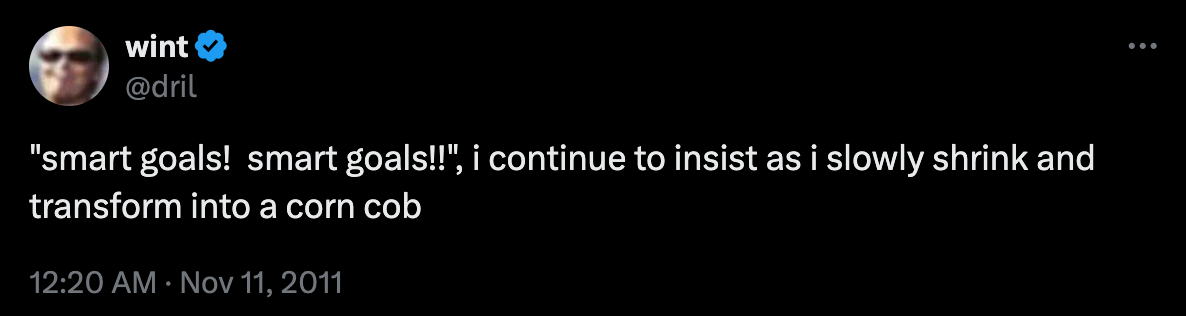
what I want to achieve is often super abstract ("move to Spain", for example), because I tend to think in very broad strokes. I'm an ideas guy, not a details guy. SMART goals are often too detailed, and feel like some corporate OKR as opposed to something I'd personally want to work towards. they stifle creativity, which is exactly what you need to bring about any sort of positive change in your personal life.
the most irritating thing I've found is I have no clue what counts as realistic, given I'm often trying to achieve something I haven't done before. even if I have tackled some goal before, my rate of progress on the second try (or third, or fourth) can vary based on my internal state. maybe I have more free time? maybe I'm fully focussed on this instead of something else? maybe I have more of the prerequisites necessary to succeed?
finally, life happens, and my priorities often shift. although that's probably related to how chaotically I live, I feel any system I adopt for life planning should be flexible enough to cater with that without making me constantly feel like shit. goals which are excessively time-bound are frustrating, as they feel like they exist in their own little world.
while trying this mindset out towards the tail end of 2025, I've realised a few things.
- I can just do things. like, I've got free will. that's pretty dope.
- the universe likely doesn't care about me or my plight. a lot of things are out of my control, often for reasons out of my control.
- it's useful to have a point to life. mine is iterative improvement and enrichment. although everything (especially my plan!) can be improved, it's pointless to weaponise the mindset. I only improve if it'll enrich.
- finding birds of a feather (or co-conspirators, as I like to call them) who see the world in a similar way I do is hugely helpful. I'm not saying I like echo chambers, but I also can't change entrenched systems alone. that means it's important to communicate my vision for the world in a way others can contribute to and coalesce around. I feel third spaces are powerful for finding like-minded people, and a sense of belonging.
- I should allow myself to get distracted, allowing my mind to wander and my spirit to explore. otherwise my plan becomes just another list I'm rushing to tick off.
- creating clear chains of reasoning is a powerful skill. I tend to chain cause, effect and conclusion together by using BLT (so, because X, that leads to Y, and therefore we should Z.)
- most failure is an issue with process, not person. you can build processes more resistant to failure using personal postmortems to understand what went wrong and how you can improve your processes to avoid it next time.
- I have influence over a small slice of reality, but I can make wider changes by encouraging others to change. I need to make a conscious effort to make change that ripples.
I'd like to improve this by
- more explicitly understanding my resources, which is currently an implicit process. I've considered using a self-hosted personal CRM of some sort (like Monica) to record the people I know and how I know them, and using something like Sure to better map out my finances
- better understanding how I can be a useful entity to others, through acquiring more useful skills. more certifications, more licenses, and more passes, please!
- writing personal runbooks for a few of my personal processes and open-sourcing some of my personal tools, and cataloguing others' personal processes and tools, to build an open library others can learn from
- meeting other co-conspirators, and building cool stuff with them
technology so often feels soulless. however, I like hacker events because they remind me we can use computers to effect positive social change. putting right people and the right technological and social tools together can pave the way for a more free, more equitable and more just society. I'd like to toy with this more over the course of the next year, in the spirit of Chaos.
I find moving with intent gives me a way to understand what I want to achieve and ties back the tasks I do to an overarching plan. it's satisfying, and I'm excited to see where this goes.
here's to 2026.